
Is AI Coming for Sign Designers?
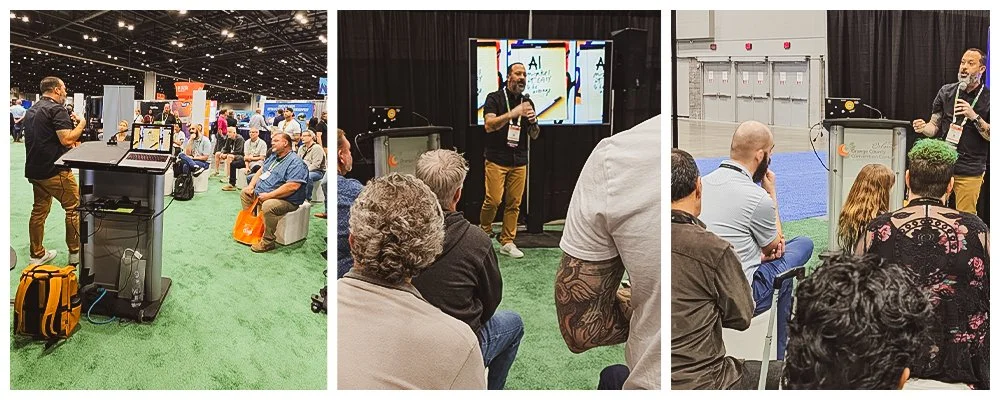
Admittedly, I’m not the most up-to-date on AI. When designers started freaking out about ChatGPT, I remained mostly unconcerned, telling people, “Home Depot didn’t put carpenters out of business.” After designing everything from brand identities to entire spaces for the last 20 years, I still maintain the belief that a designer’s value isn’t in their knowledge of software or their ability to expertly push pixels. It has always been our taste, critical thinking, and unique problem-solving that determines our worth.
However, ignoring AI isn’t an option. So when the International Sign Association asked me to speak at the 2026 ISA Sign Expo, I knew I had to share my personal thoughts on the mechanical gorilla in the room—artificial intelligence.
Sign-of-the-Times recently shared results from their “2026 Big Survey,” revealing that 59% of respondents use AI in their business. While I expected these results for office tasks like email or estimating, I was surprised to learn that 50% of sign shop owners admitted to using AI for design.
Designing signage requires knowledge and expertise far beyond what AI can generate from even the most thoughtful written prompt. If AI had the ability to understand a new business’s brand, accurately review construction documents, and determine opportunities for unexpected moments of “wow,” it would save me lots of time and money. But computers don’t think. Designers do, and in order to retain their position in this industry, sign designers need to lean into the parts of our job that require a pulse.
Show your work
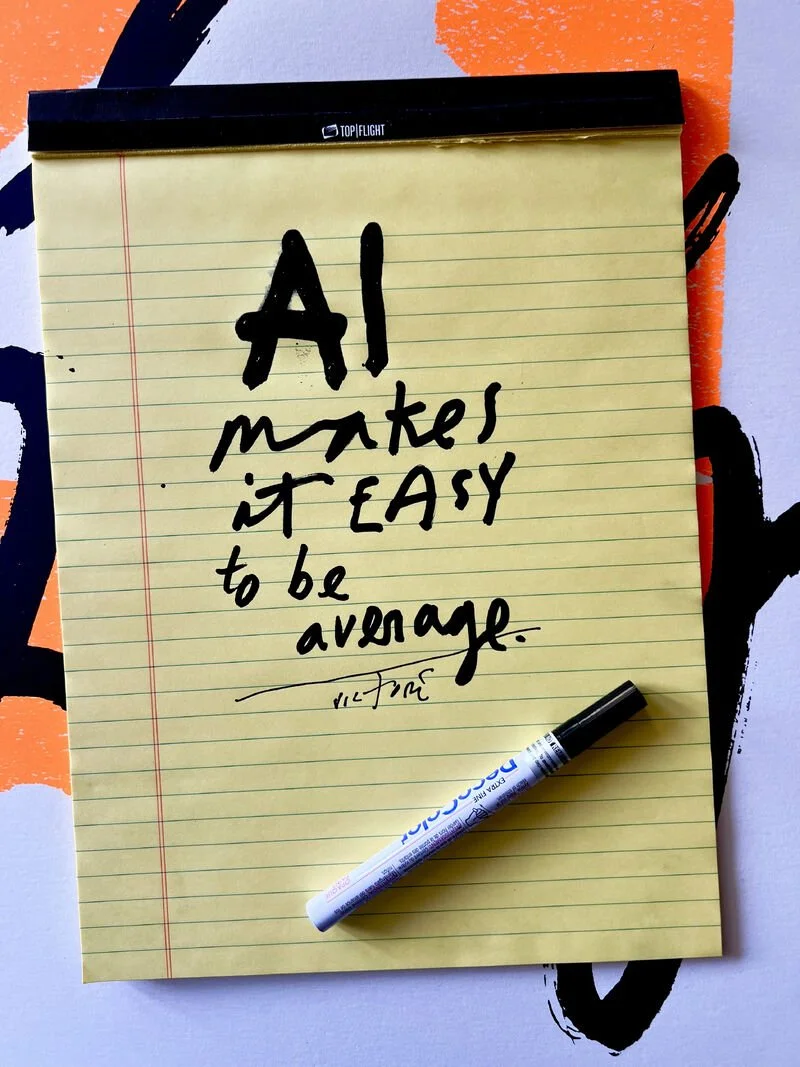
credit James Victore
Sign codes and regulations might feel like they limit creativity, but they also work in your favor. ADA regulations are rigid. City sign code is usually vague. And property sign criteria, if it’s even available, is narrow and antiquated. Artificial intelligence, no matter how well-prompted, won’t reliably interpret requirements or make sense of confusing specifics hidden throughout multiple documents.
As a sign designer in the age of AI, it is your job more than ever to show your work. It’s important that both your team and the client understand the time and knowledge poured into researching sign code, exploring nuances and contradictions, and finding the gray areas that allow for compliant, boundary-pushing design solutions.
Only when they understand what really goes into the work will they value. This is unfortunate, but when everyone thinks they can do your job they need to know what really goes into it.
Present your work
While not every designer is a salesperson, there are even fewer salespeople who have any knowledge of design. I’ve been saying this for years. It’s vital the design team be included in any creative meeting and client presentations. Designers need to present their research and moodboards, explain their process, and walk through various directions and the thinking behind each of them. Designers need to present their work!
When the designer presents their work to a client they build rapport and respect. Their expertise is almost immediately acknowledged and the work is revered. You’re less likely to have clients reply with arbitrary feedback like, “make it bigger,” when they understand the logic and intent behind the work. Again, few designers have the gift of sales, so it’s best when the two teams present in tandem. In unison, like playing an instrument, great music is only made when both hands work together.
Defend your work
Even after showing and presenting your work, there will be some clients who think it’s a good idea to take your work and “run it through AI.” This will happen more frequently and will be incredibly frustrating. But don’t give in, defend!
It’s imperative that designers learn to hold their own. Knowing the “why” behind the work is essential to presenting and defending it. Feedback isn't just expected; it’s necessary to push good towards great. But, if a client would rather feed your work to an AI model instead of providing feedback, call them out on it, not in a confrontational way, but inquisitively. What wasn’t working? Was there something we missed? What prompts did you provide AI when you uploaded our designs? It may be uncomfortable, but it invites dialogue. Once a client understands that design is a process that requires feedback, they are less likely to sneak off to ask for artificially intelligent input.
So, back to the initial question, is AI coming for sign designers? Yes, but not in the way some might have thought. It’s just another new tool, and we often reject what we don’t understand. Until we know its true helpfulness, AI will be that uninformed new guy with an opinion on everything. If clients want to play around with it to get a taste of being creative, don’t get frustrated. Instead, help them feel involved by showing them your process, walking them through your process, and sharing the “why” behind your work. You, a sign designer, are still what make great ideas a reality, and computers have yet to come up with ideas on their own.
We’d love to hear your thoughts and and feelings about AI and what changes you’ve had to make in the wake of it.

Are you a Designer?
Sign up for our monthly newsletter and learn more about designing for spaces & places, the good work we’re doing, and the good people we’re doing it with.